
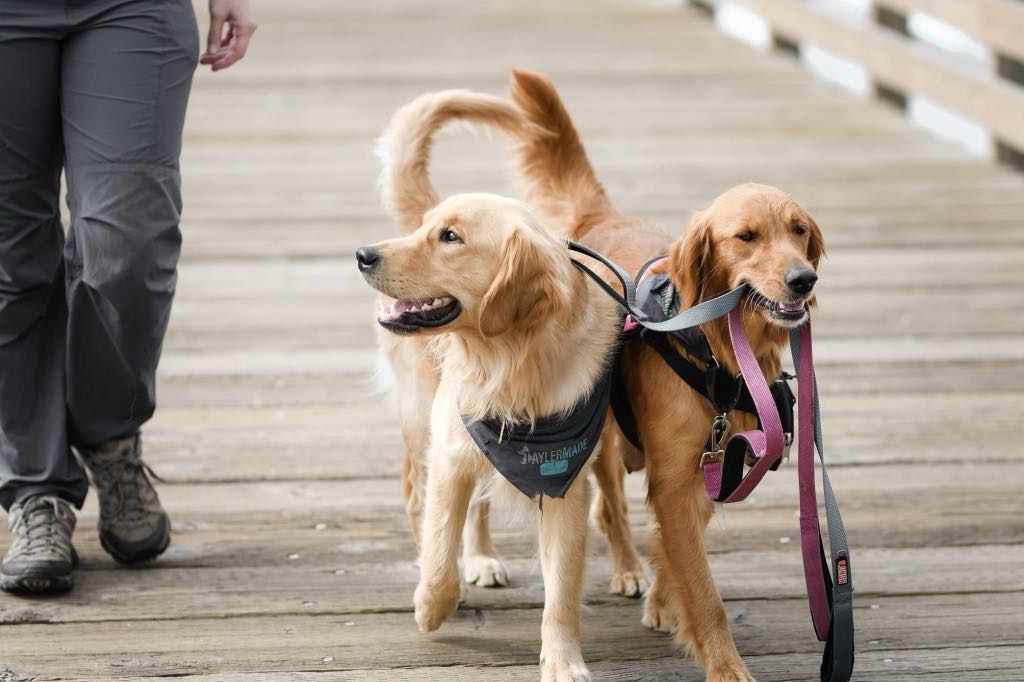
What My Service Dog Taught Me About Trust, Communication & Adventure
Lessons from life with Bailey, the Golden Retriever who taught me that the strongest partnerships aren’t built on control. They’re built on understanding.
Meet Bailey — My Co-Pilot in Life
Hi, friends! I’m Tayler, a Certified Professional Dog Trainer (CPDT-KA), author, and lifelong animal advocate. But more than anything, I’m a proud partner to a Golden Retriever named Bailey.
Bailey isn’t just my service dog. She’s my co-pilot in life.
Together, we’ve traveled thousands of miles by motorcycle through sunshine, rain, fog, and just about everything in between. Through every twist of the road, she’s been my anchor in the storm.
Working with Bailey changed the way I see the world. Our partnership taught me that meaningful training is about so much more than teaching a dog to follow cues.
It’s about communication, trust, consistency, and mutual respect. What started with obedience lessons grew into a partnership that has taught me as much about people as it has about dogs.
What a Service Dog Really Does
Let’s clear up one of the biggest misconceptions: a service dog isn’t simply a really well-behaved pet.
Service dogs are individually trained to perform specific tasks that help a person with a disability. Depending on their handler’s needs, those tasks might include medical alerts, mobility assistance, retrieving important items, or interrupting disability-related symptoms or behaviors.
But behind those trained tasks is something incredibly important: a working partnership.
A service dog may need to recognize subtle changes in their handler, respond to specific cues, and remain attentive in busy environments.
When someone calls out to a working service dog, reaches to pet them, or tries to distract them, that interruption can interfere with the job they’re doing.
Whether or not a dog is wearing a vest, the respectful choice is to avoid distracting a working service dog without the handler’s permission.
It’s Not Control — It’s Communication
One of the most important lessons Bailey has taught me is that communication should go both ways.
My goal has never been to create a dog who simply follows instructions without question.
I want Bailey to understand what I’m asking, feel confident in our partnership, and trust that I’ll consider her safety and needs.
Clear cues, consistent expectations, reinforcement, and mutual understanding are what make our teamwork possible.
This belief inspired my first book, My Best Friend Bailey, a children’s story about empathy, teamwork, and understanding the important work service dogs do.
Dogs Are Talking — Are We Listening?
Raise your hand if you can tell when your partner is upset before they even say a word.
That’s body language, and dogs are communicating with us all the time.
The challenge is learning to recognize those signals and understand what they mean in context.
- Stiff posture, a tense mouth, or a sudden freeze: Your dog may be uncomfortable or concerned.
- Loose muscles, soft facial expressions, and relaxed movement: These can indicate a dog who feels comfortable.
- Looking away, lip licking, or yawning: Depending on the situation, these may be signs of stress, uncertainty, or an attempt to avoid conflict.
- Tail wagging: A wagging tail indicates emotional arousal, but doesn’t automatically mean a dog is happy or friendly.
The key is to look at the whole dog rather than relying on one signal.
Understanding canine body language can help us recognize discomfort, prevent conflict, and respond before a situation escalates.
Sometimes when your dog turns their head away, they aren’t ignoring you. They may be politely asking for a little space.
Kind of like pretending to check your phone to avoid small talk at the grocery store.
They Read Us, Too
Here’s something many people forget: dogs are paying attention to our behavior, too.
They notice our movements, tone of voice, routines, and emotional expressions.
When I’m frustrated or distracted, my communication can become less clear.
When I slow down, become more intentional, and communicate consistently, Bailey has a much easier time understanding what I need.
That doesn’t mean our dogs perfectly mirror every emotion we feel, or that an anxious dog is always responding to an anxious owner.
It means our behavior is one important part of the environment our dogs experience. And that’s something we can work on together.
Behavior That’s Reinforced Gets Repeated
Dogs don’t need to act out of spite to develop behaviors we find frustrating.
Often, they’re simply repeating something that has worked for them before.
If barking consistently earns attention, that attention may reinforce the barking.
If sitting politely earns something valuable, like a treat or an opportunity to go outside, that behavior may become more likely.
It’s the same reason we might post more photos when one gets a ton of likes. Feedback influences what we do next.
Understanding this gives us a powerful training tool: rather than focusing only on stopping unwanted behavior, we can teach and reinforce what we’d like our dogs to do instead.
The Science Behind the Training
Here’s something that surprises a lot of dog owners: the dog training profession isn’t universally regulated through a mandatory professional license.
That’s one reason earning my CPDT-KA certification was important to me.
I wanted to demonstrate my commitment to professional knowledge, ethical practice, and continuing education.
Good training should be thoughtful, informed by behavioral science, and adapted to the individual dog.
Fear and intimidation can interfere with learning and damage trust.
My philosophy is simple: understand the dog in front of you, communicate clearly, and build skills that work in real life.
Adventure Is Enrichment
Bailey and I have camped under the stars, crossed mountains, and explored the country together on my motorcycle.
Every journey has reminded me that adventure isn’t just about getting somewhere new.
It’s about experiencing the world together.
New sights, smells, sounds, and environments can offer valuable enrichment when introduced at a pace that’s safe and comfortable for the individual dog.
For some dogs, adventure means a hiking trail. For others, it might mean exploring a quiet park, investigating new scents, or trying a simple enrichment activity at home.
The goal isn’t to push every dog into bigger experiences. It’s to discover what makes their world interesting, fulfilling, and enjoyable.
Our experiences inspired my second children’s book, My Best Friend Bailey’s Adventures, a story about courage, exploration, and the bond that grows when we step into the unknown together.
The Lesson I Keep Learning
If there’s one takeaway from life with Bailey, it’s this:
Dogs are always teaching us something, if we’re willing to listen.
They teach us patience when we’re frustrated, forgiveness when we make mistakes, and presence when we’re distracted by everything else happening around us.
We spend so much time trying to teach dogs how to fit into our world.
Maybe we should also spend a little more time learning how to understand theirs.
Keep Learning With TaylerMade
Looking for more practical dog training advice, behavior insights, and everyday inspiration?
Explore The Dog Owner’s Guide Visit TaylerMade